
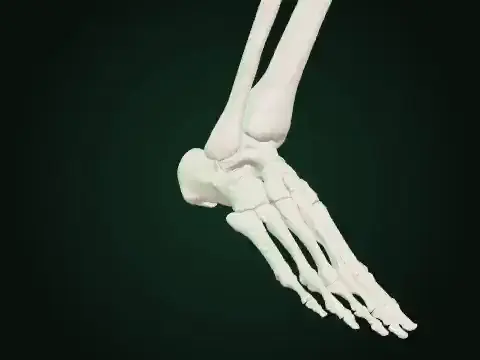
Combined fifth-ray reference arc · BETA
About this resource
Ankle/proximal foot held; authored native midpoint and paired extremes. Full selected reference scalar, carried symmetrically about the original native midpoint on an authored fixed axis. The published pin-angle difference does not specify anatomical plane, neutral, axis, translation or complete orientation; this source-vector proxy does not reconstruct the experimental pins or claim normal in-vivo maximum. The experiment immobilized the ankle in neutral, removed the toes and applied one-pound weights at the distal first/fifth metatarsals in ten fresh-frozen, below-knee specimens. The selected Table 1 mean used 9 valid joint pin pairs (SD 8.73°). Its unloaded, nonphysiological extremes and pin-angle method do not establish normal patient ROM, a sagittal-only angle or complete three-dimensional orientation. Actual central-shaft dorsal/plantar source vertices define an authored reference vector, projected perpendicular to the authored carrier axis. Original experimental pin positions are unavailable; this is not a reconstructed pin pair. The readout measures that actual projected native bone vector from the authored first extreme; axis and midpoint are authored. Original complete muscle course, held guides and actual first/fifth-metatarsal ownership persist. Native phalanges follow the metatarsal rigidly as context, rather than recreating the amputated-toe specimen or adding toe-joint motion. Relaxed returns to the first posed extreme; Rest anatomy restores the original native source. The selected muscle participates without a claim of isolated full-arc force or recruitment. All six Foot muscle bodies remain on this single actual ray pose. The selected participant is active; the opposing source route stays passive where represented. One shared actual bone timeline carries every participant and connected surface. Activity is an illustrative teaching signal, not force, EMG or measured recruitment. Passive antagonists have zero activity; passive lengthening is not automatically eccentric contraction. The return reverses the same geometry with the selected group active. Contact, tendon strain and loaded gait are not solved. BETA teaching approximation; no clinical or faculty validation is claimed.
Inspect the selected source model and its visible limitations.
Model & sources
simLAB · original anatomy teaching source
Source-owned teaching illustration, not a clinical measurement. See the player for its scope and sources.