
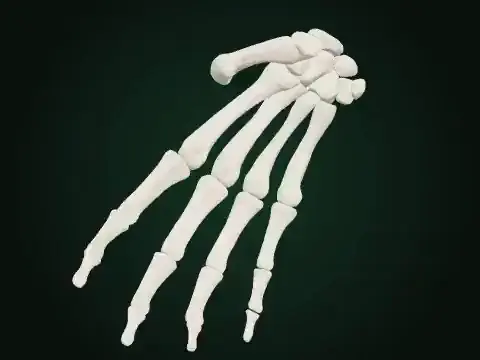
Combined fifth-ray cupping · BETA
About this resource
Source-relative CMC5 zero; fingers carried with metacarpal. Complete original textured Opponens digiti minimi retains its actual Hamate/flexor-retinaculum origin region and fifth-metacarpal attachment. Bade1993 reports full10–15° flexion and subsequent10–15°supination in50metacarpal bases; this illustration uses the upper full component15°. Supination starts with CMC5 actually flexed15°. The fifth metacarpal carries all three fifth phalanges; other finger joints keep their native relationships. The native source posture defines added-angle zero, not the separate2020fist-aligned arch-test zero. This is a partial opposition role. The24.3°active metacarpal-arch test, composed thumb contact, coupled adduction/variable axes and contact/force mechanics are not modeled. NativeRest differs from the posed supination starting setup. This one coordinated task follows the reported order:15 deg CMC5 flexion, then15 deg supination. Original native ODM plus19 complete finger muscles share its actual bone timeline; passive digital routes follow the fifth ray rigidly while other native rays stay held. Small ADM/FDMB activity is an explicitly authored stabilization illustration. It is not a normal hand-arch maximum or thumb-contact task. One actual bone timeline drives every original source body and shared owner. Activity is authored teaching emphasis, not EMG, force, tendon strain or physiological recruitment. Antagonists and other passive context have zero activity; passive lengthening is not automatically eccentric contraction. The selected group remains active during the authored controlled return. Native source identity and exact Rest/reset are retained. BETA teaching approximation; no clinical or faculty validation is claimed.
Inspect the selected source model and its visible limitations.
Model & sources
simLAB · original anatomy teaching source
Source-owned teaching illustration, not a clinical measurement. See the player for its scope and sources.